

Now Reading: Best Places to Visit in Perambalur – Temples, Hills & Historical Sites
-
01
Best Places to Visit in Perambalur – Temples, Hills & Historical Sites
Best Places to Visit in Perambalur – Temples, Hills & Historical Sites
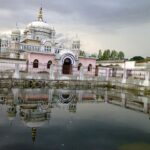
1.Arulmigu Siruvachur MathuraKaliaman Temple
Temple History
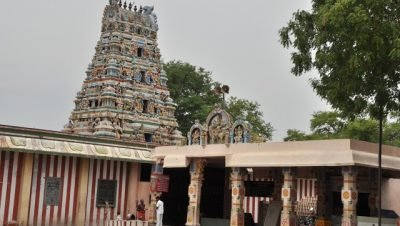
Famed Arulmigu Mathura Kaliamman temple at Siruvachur, 50 kms from Trichy and 8 kms from Perambalur is said to have turned hundred years old. Huge crowd of devotees visit this temple on Mondays and Fridays to worship the mighty deity and get her divine blessings. Siruvachur local deity Chelliamman as per tradition. An wicked magician contrived, through the strength of his devotions, to please her. Happy with his devotion, Chelliamman granted him any thing that he desired. He wished that the deity should be his servant and do his bidding forever. Refrained under the power of own boon Chelliamman could do only follow all his evil command.
Now Kannagi the very goddess of virtue and chastity, happened to come to Siruvachur at this time. Kannagi was the loving wife of Kovalan, a trader. Kovalan and Kannagi led happy life together till Kovalan on his travels met Madhavi a beautiful danseuse. Enthralled by her beauty Kovalan began to reside with her and squander all his wealth at her behest. This continued for more than a year during which he had a child Manimegalai with her. When he was depleted his sense Kovalan understood his mistake and returned to his loving wife Kannagi. The couple went to Madurai to make ends meet. Kovalan, which by now was in a very pressing need of funds, went to the extent of trying to sell one of the most precious anklets of his wife. Theanklets looked exactly like of a Madurai queen and so Kovalan was accused of theft and mercilessly beheaded by the king without even conducting a trial. When this, the angry Kannagi, rushed on to the king’s court and charged, that by his zeal and hasty judgment, he had robbed a man of his life. Anger visibly boiling inside, she pulled out that other anklet and threw it over. The whole city of Madurai went up in flames instantly by the virtue of her chastity.
Temple Opening/Pooja Times
- Temple Opening Time : Morning 6.30 A.M to 9.00 P.M
- Abishgam Time : 11.00 A.M to 12.00 P.M.
- Uchikala Pooja Time : 1.00. P.M to 1.30 ( Golden Kavasam )(
2.Arulmigu Ekampareshwarar and Thandayudhapani Temple
Historical Greatness of the place
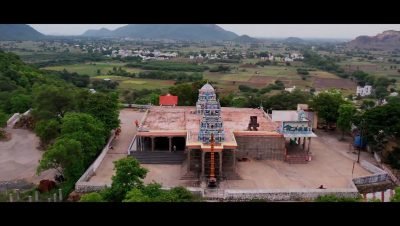
Earlier this place was covered with a thick canopy of kadamba trees. Chola king was ruling with uraiyur as capital. At that time, a Trader from his region, proceeded towards to trade North, from uraiyur. When he came to kadambavanam it was evening, and dark. So he ceased his journey and made his bed there. He climbed on to a Banyan Tree and sat on it.
A Flash of light manifested itself all at once like fire in the dead of the night to which was the form of Shivalinga between the Lords and Saints, doing puja to, and then it vanished. The trader was witness to this beautiful spectacle. Full of amazement trade back to his own town in uraiyur in the morning and he informed the chola king.
Reaching Uraiyiur, the trader told that spiritual scene to the Great king parandaha cholan in his palace.
Kulasekara Pandian, the guest of honor to Chennai chola King heard about the miraculous event. The chola and pandian king along with the merchant and the soldiers arrived in kadambavanam, They looked for the shivalinga somewhere in every direction. At that moment, there was an old man with a sugar cane in hand, showed them the place of linga, shivering and vanished suddenly, like a flash of light in the Eastern direction. The Kings were struck with amazement in the distance from a little hill on which Lord Muruga stands as Thandayuthapani with its sugar cane.
Both the kings were very much inclined towards Bhakti and Kulasekara Pandian built both the Ekambareswarar and Thandayuthapani temple at the same time.
Sooriya Pooja
Towards the east Arulmigu Thandayuthapani on the hill is facing his Father westwards is only unique feature.
When On the 19 20 21 days of panguni month the sun rays diminishes the samara his rays fall on Shivalinga gradually works down of kamatchi amman. This miracle attracts devotion of many devotees to come and witness on 19,20,21 dates of maasi month when the sun’s rays falls on Lord Thandayuthapaani as the sun sets.
Pooja Time
- Morning 8.00 – 9.00 (Kalasandhi)
- Afternoon 11.30 – 12.00 (Uchchikalam)
- Evening 5.30-6.30 ( Saya rakshai )
- Night 7.30 – 8.00 ( Arthasamam)
3.NATIONAL FOSSIL WOOD PARK
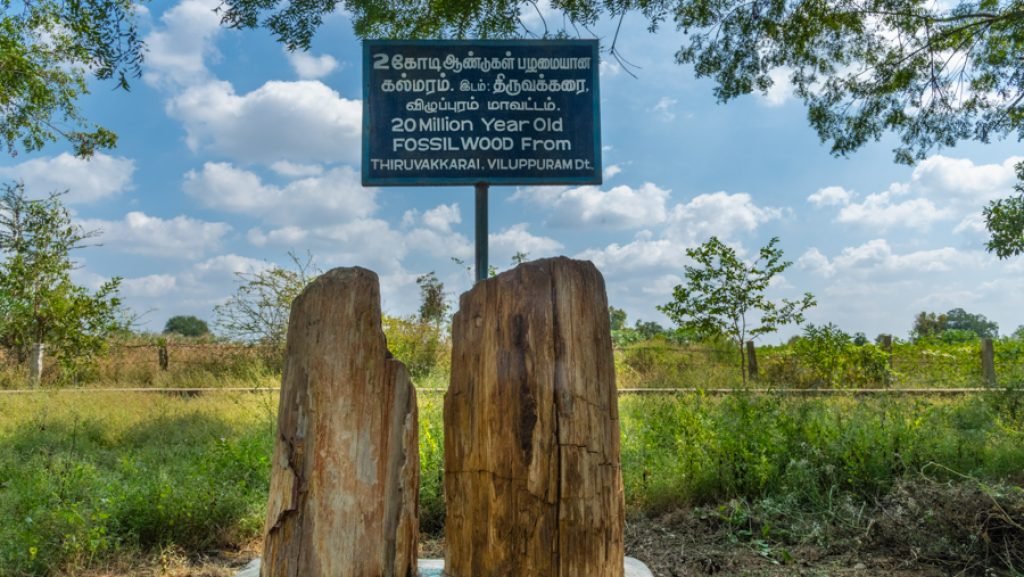
The geological study reveals that more than 120,000,000 years, ago the sea (which is at present, about 100 k.m. East of Sathanur) had invaded as far as 8 to 10 km East of Sathanur. At that time, which is said to be the geologically known cretaceous, the sea swarmed in sort of marine animals the same an the ones found in at present philippine sea. These animals, after decaying, settled on the floors of rivers, and were covered by sand and clay transported down by rivers, and fossilized from such conditions. Along with them some of the trees which grew on the coast land or in the immediate proximity of the shore were also carried away and buried after burial by flooded streams and were endowed in the course of time.
The huge trunk of petrified tree which is shown here can be seen among the Trichirappalli group of rock formations of about 100,000,000 years ago. This tree proves the existence of Conifers (The non flowering plants) which was the land vegetation before the time of Angiospems (the flowering plants of today).
A petrified log of the Sathanur measures over 18 meters in length. Similar fossil trees ranging from few metres to the length of this, are known from the present stream sections of Alundalipur, Saradamangalam and near Anaipadi and Varagur. It was Dr.M.S.Krishnan of Geological Survey of India, who first reported this fossil tree in 1940.
A museum and a children’s park is available at the National Fossil Wood Park at Sathanur as an educational centres.
Touted as Sathanur Petrified Tree Educational Center, it would give information and would also spread awareness to the visitors on the importance of the fossil tree in the site and the region.
The Education Center built as a part of project contains four energy halls with illustrations on the solar system, origin of earth, big bang theory, origin of life and evolution, and the petrified tree. Fossils found in the area have been housed in the museum.
4.Ranjankudi Fort
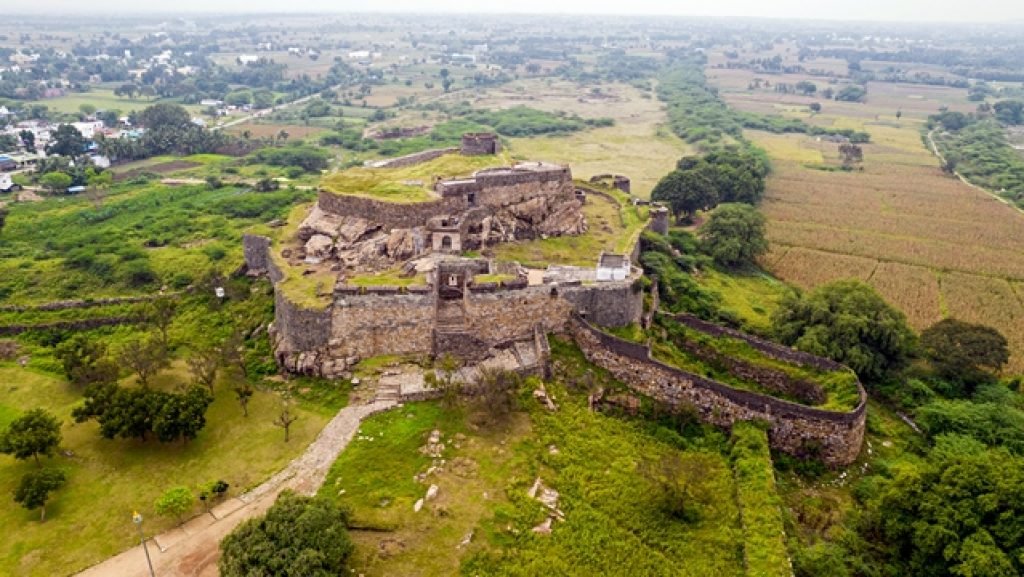
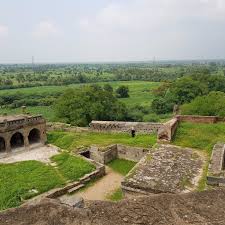
Ranjankudi fort is a 17th-century fort located some 22 km (14mi) north of the town of Perambalur, Tamil Nadu,India. The fort is situated at a site 22 km north of Perambalur NH 45 in South Indian state of Tamil Nadu. It is located 253 km (157mi) from the state capital Chennai and 70 km (43 mi) from Trichy.The Fort was raised by feudatory Nawab of the Carnatic.
Ranjakudi fort had been the point of focus in the Battle of Valikondah in 1751, when the British troops led by the side of Mohammed Ali shook solemnly past the French backed Chanda Sahib. The fort is of an oval form, with semicircular bastions, enmoated and with three bulwarks in different levels, constructed with the locally available cut stone. The fort has a palace, residential buildings and underground chamber and also an underground tunnel connecting Pettai (top level) and Kottai Medu (lower level). The fort is today sought after maintained and controlled by the Archaeological Survey of India.The fort is among the most needed traveler destinations in Perambalur.
History
The fort is known as Ranjankudikottai and also as Nanjankudikottai. The old place is thought to have contained Hindu temples Shiva and Hanuman The fort is believed to have built by Jagridar of the Nawab of Carnatic in 17th century. The fort was the site of the Battle of Valikondah in 1751. The British were backed by Mohammed Ali, while French were behind Chanda Sahib. Isn’t though the battle said by the village Valikondah, but there was a fight in the fort. Though the French got a first victory, British won the final battle thanks to the Muslim population.
In May, 1752, the fort had also witnessed the surrender of French troops under D’Auteuil, which was sent to relieve the garrison at Srirangam . D’Auteuil was placed at Uttatur and repelled by the British forces led by Dalton on May 9th. He retired to Ranjankudi, where the Jagirthar sided with the British and refused entry to the French soldiers to the upper part of the fort. D’Auteuil surrendered in the fort.
Related articles : Best Places to Visit in Namakkal – Forts, Temples & Nature Spots



Pingback: Best Places to Visit in Pudukkottai – Explore Heritage & Culture