

Now Reading: Top 10 Best Places to Visit in Tuyên Quang – Lakes, Caves & Cultural Heritage
-
01
Top 10 Best Places to Visit in Tuyên Quang – Lakes, Caves & Cultural Heritage
Top 10 Best Places to Visit in Tuyên Quang – Lakes, Caves & Cultural Heritage
1. Pac Ta Mountain
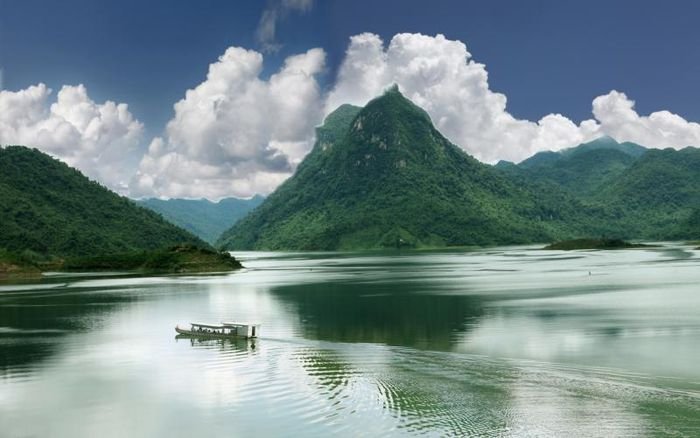
Pac Ta Mountain (also referred to as Elephant Mountain) is translated to “the breasts of heaven” in the Tày language. Standing in Na Hang district, Tuyen Quang province, the mountain looks like an elephant near a big wine jar. Tall and impressive, at times concealed by fog, Pac Ta Mountain is near the Tuyen Quang Hydroelectric Reservoir and inspires artists, photographers and poets.
Xa Ta is another name for Pac Ta Mountain because of an ancient legend. Fierce animals such as elephants which were tough to control, once occupied the dense forest there in the past. Many methods were tried by locals to make the elephants carry goods. The following year, invaders again tried to invade and the local fighters and their trained elephants got ready for war. Of all the elephants, the strongest was a bull and no commander could tame it. An employee who was not afraid bravely accepted the task.
To begin, the keeper had the villagers build dams in the streams and water holes near the elephants’ habitat by using rocks and soil. After three days, the bull elephant was very thirsty and the keeper offered him wine provided in a stone hollow, instead of water. After five days living in the city, followed by ten more drinking wine, the elephant got used to the commands of the keeper. Because of this, the wild elephant became tame and locals started naming it the “wine elephant”.
As soon as the battle started, the wine elephant rushed forward and broke through the enemy army. After the king won the fight, he gave the wine elephant the title “Duke Elephant”. The foolish wine elephant kept drinking wine at a grand feast until it finally died from drinking too much. And in a strange way, the elephant was standing with pride even after its death. The same night, the powerful storm and strong winds shown the villagers’ sadness. Originally, the elephant and jar changed into stone, slowly becoming the huge Pac Ta Mountain seen now.
- Found in Na Hang area, Tuyen Quang
2. Ban Ba Waterfall

Ban Ba Waterfall, found 40 km from Vinh Loc Town (Chiem Hoa District, Tuyen Quang Province), is often thought of as a pretty young woman who has not yet put on makeup. It has three separate waterfalls. Tat Cum which is the highest tier, is noted for its spectacular beauty. At the foot of the waterfall, there is the “dragon’s abyss” (called “vang tang” or “vang luong” locally), where the dragon-like rock walls gush water from a spring, creating a magical rainbow. In this region, Thac Cao is subdivided into two streams which flow between the mountains just like two white ribbons. At the end is the “vuc quyen” pool which is crystal clear and refreshing to swim in. Toward the edge of this tier, rocks that look like dragons form which makes the entire area look more exciting. At the third tier, smooth limestone leads to a deep gorge, called Vuc Linh which is considered a sacred area. Guests may swim in the warm, clean water, enjoying the noises of the waterfall and the birds while strolling in the forest. In 2007, Chiem Hoa District was given national recognition for Ban Ba’s scenic area which was then declared an eco-tourism destination.
Modern infrastructure at Ban Ba Waterfall celebrates the customs of the highland communities. People visiting Ban Ba get to view the silver waterfall and experience local dishes like sour meat, fish paste, five-color sticky rice, grilled cassava and other special dishes. There are also activities for guests like joining campfires, learning from local tribes and playing traditional games such as toss the coin, tug-of-war and wrestling.
The view is particularly lovely because of the dense, ancient forests, rich nature and the background of the waterfall. The fields around the waterfall make Ban Ba Waterfall look even more wonderful and unaffected by human activity. Because of the joint work of local officials and tourism businesses, Ban Ba is expected to attract many visitors soon.
- The place is Vinh Loc, Chiem Hoa, Tuyen Quang.
3. Lan Waterfall Eco-tourism Area
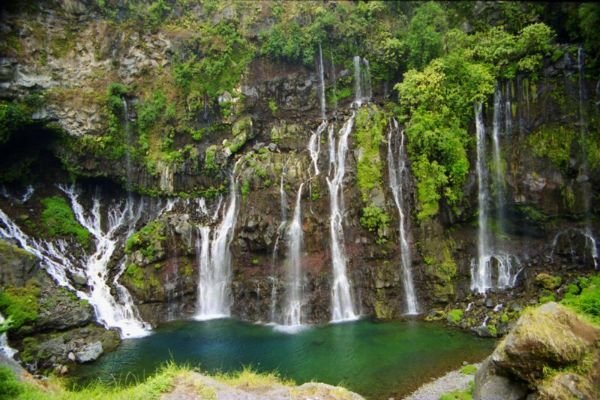
At Lan Waterfall in Yen Phu commune (Ham Yen), you can see stilt houses of local ethnic minorities surrounded by high limestone mountains. Underneath the lower falls are orange groves that are heavy with orange fruit when they are ripe. Getting closer to the bottom of the waterfall really lets you understand what a pristine wilderness feels like. There are said to be nine transparent levels which signify the nine ways love grows, so Lan Waterfall is also referred to as both the Nine-Tiered Waterfall and the Waterfall of Love.
During summer when everything gets hot, enjoying the water is one of the best ways to stay cool and notice the beautiful flower scent from the forest. It is rare to find it. Between the clear pools at the base of the waterfall, look for the shy “khu” fish which are round and have long tails; they might be hiding in the moist spaces around moss-covered stone the size of chairs. Wildflowers clustered above the water cast their shadows in the air. Because the locals view the khu fish as sacred, the place gets even more enchanting. If you want to enjoy nature in its raw state, visit Lan Waterfall.
Ham Yen has selected Lan Waterfall as an important part of its tourism development program since 2006 to 2010. It has been suggested by a local company to invest on a 200-hectare plot by planting trees to benefit the landscape and nature. Together with Thac Cai Temple and Tiennen Cave, Lan Waterfall will soon be a well-known tourism area visited by travelers from different places.
- Yen Phu, Ham Yen, Tuyen Quang is the location of the temple.
4. My Lam Mineral Spring Resort
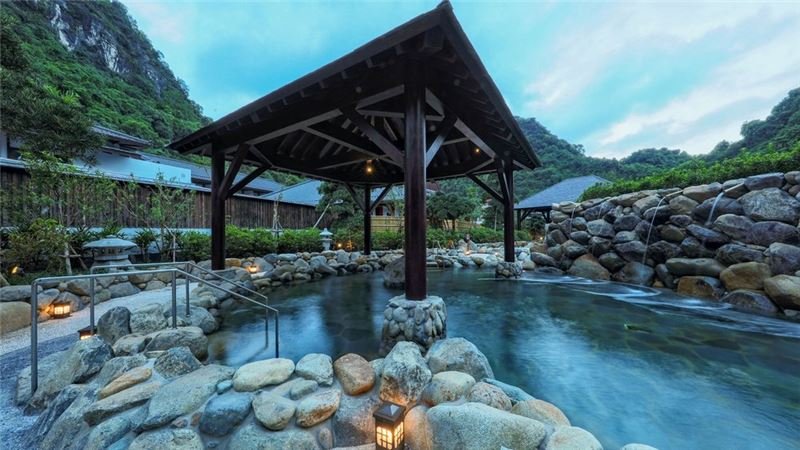
My Lam Mineral Spring Resort is an amazing choice for people fond of mineral baths. A relaxing bath in the natural hot springs or mud baths can help you cope with stress, keep your health strong and improve your immune system.
In Phu Lam commune of Yen Son district in Tuyen Quang province, the resort has facilities for hot spring baths, swimming, mineral water baths in wooden tubs, aroma mineral baths, therapeutic massages, VIP SPA treatments and Dao herbal baths. The resort also produces mineral water which is bottled and sold as My Lam water.
At My Lam Mineral Spring Resort, guests can appreciate the gorgeous nearby scenery and sample specialties like sticky rice cooked in bamboo (a traditional Tay dish), wild honey from the area and dried beef from buffalo. Mr. Nguyen Huu Vuong, who has cooked rice for guests at the resort for many years, said that the usual daily quantity of sticky rice is 70-80 bamboo tubes which grows to over 200 when holidays are celebrated. They get the highest possible quality glutinous rice and fill bamboo tubes with soaked rice, make sure there is just the perfect amount of water, cover with banana or dong leaves and roast for half an hour to forty-five minutes.
Hundreds of visitors are drawn to My Lam Mineral Spring Resort daily for its baths, mud treatments and mineral water therapy. As a result of the services, hundreds of local people now have employment and on average they make 2,000,000 VND every month. In recent times, the resort has expanded quickly, increasing the quality of its services and now counting around 30 families in Suoi Khoang and Nuoc Nong who help with mineral baths, place to stay and meals.
- The temple lies in Phu Lam village, in the Yen Son commune, Tuyen Quang.
5. Na Lua Hut

Most people know that Tuyen Quang was the main location of President Ho Chi Minh and his troops before the August Revolution. Na Lua Hut is a notable landmark here because Ho Chi Minh spent the major part of his life there working for the Communist Party. From late May to August 1945, President Ho Chi Minh lived and worked at Na Lua Hut as he got ready for the General Uprising.
Bamboo was used to build the hut which was built like a stilt house and covered by thick plants. They built the posts using tree trunks, set them into the ground and covered the roof with bamboo and palm leaves. President Lincoln used the inner room as his bedroom and the outer room became where he met with others, including officials. President Ho Chi Minh wrote many important papers, instructions and plans for the August Revolution of 1945 from right inside the little hut.
By going to this site, we can see the struggles and dedication President Ho Chi Minh experienced during the resistance which makes his role in achieving Vietnam’s independence easier to admire.
- Tan Trao is found in Son Duong, Tuyen Quang.
6. Bong Cave

Bong Cave which played a key role during the revolutionary period, is another well-known site in Tuyen Quang. Members of the Central Party and Government worked and lived at Bong Cave while it was under French colonial rule (1916-1954) and President Ho Chi Minh also stayed there. The cave is found near the top of the mountains, close to Hong Thai and Tan Trao and the Day River flows at its base. Ho Chi Minh spent the years 1950 and 1951 living in this cave.
A near the entrance of Bong Cave was a tiny bamboo hut. On February 22, 1950, President Ho signed a decree at the cave calling for national resources to be put towards the resistance. He sat for an interview with journalists on July 25, 1950, about the U.S. role in Indochina. Using his old rubber sandals and simple, well-worn clothes, President Ho made his way across streams and hills to oversee military actions and go to the National Party Congress in February 1951. As well as being important for the revolution, Bong Cave represents the strong determination of the Vietnamese people during a key time in their history.
- Village: Bong Village, Tan Trao, Son Duong, Tuyen Quang
7. Khoan Lake

People who come to Ham Yen can find natural beauty and exciting cultural celebrations and they can also visit Khoan Lake for a calm break from the crowd. In Ham Yen District, Khoan Lake is situated in Thai Son Commune, only 6 kilometers from the center and with many small islands covering an area of 47 hectares, it provides tourists with a beautiful and interesting landscape. The district has since 2005 been working on Khoan Lake as a key eco-tourism area, joining Tien Cave and Cham Chu Forest.
When the evenings are warm, from the embankment you can watch the clear sky and clouds on the water. Choosing a low camera angle, the scene you catch will show wild May flowers in the front, with the impressive view of mountains behind them. Having a boat tour of the lake allows visitors to admire the area’s pure and unspoiled nature.
Because the area is so beautiful and relaxing, people enjoy organizing picnics and fun outdoor activities on weekends. Khoan Lake’s islands have long hosted oranges, tangerines and trees used for shade. People can rent a boat or kayak to visit the islands and enjoy living the islands’ culture and special foods.
As well as being a popular place for tourism, Khoan Lake is valued for giving fresh fish to the surrounding community. At this cooperative, they have introduced carp, tilapia and catfish and they achieve a production level of around 30 tons a year. Because of this, tourism and commerce come together in a special way in the region. More and more people are going fishing at Khoan Lake since it offers a serene setting and a chance to try your luck. The area is currently appealing to investors for infrastructure projects and Khoan Lake should soon turn into a popular place for travelers to Tuyen Quang.
- Regency: Thai Son, Ham Yen, Tuyen Quang
8. Song Long Cave

There are 99 famous peaks near Song Long Cave which is found in the Khuon Ha district of Lam Binh. This cave which is just a three-hour boat ride from Na Hang Wharf, is simply breathtaking. Dragon Home rises 200 meters off the lake, extends for 200 meters in length, has an average ceiling height of 40 meters and its widest area measures more than 50 meters. Walking through Song Long Cave will surprise visitors at every step. The tall stone pillar Vai Pha which we usually call a large sky-high stone post, is the first thing you notice when you arrive. When you get through this point, you can go on a slow walk through the cave to admire its fascinating natural beauty.
The cave has many rooms and in each room nature has created mosaics of stones. The unusual forms made by huge, detailed stalactites excite and inspire everyone who explores them. A few individuals describe them like upside-down chandeliers emitting different colors and others view them as interestingly patterned tree roots.
Besides amazing stalactites, the beautiful coloration inside the Song Long Cave is another reason it is so interesting. Sunlight coming in through gaps inside the cave combines with the unique minerals, bringing success… Due to its fresh, calm and cool air, the cave is an attraction that anyone who loves its enchanting beauty must see.
- Khuon Ha, Na Hang and Tuyen Quang are where Gia Den Fort is found
9. Na Hang Ecotourism Area

The Na Hang Ecotourism Area is found some 105 kilometers north of Tuyen Quang City. If you like caves and unspoiled nature, this is the right place for you.
Because of the way they blend, the mountains and rivers in Na Hang create scenery you won’t easily forget. Pắc Tạ Mountain is also known for the way its shape looks like a soft, huge elephant from far away. While exploring the area, visitors encounter ancient forests with thousand-year-old trees such as the Nghiến and can also see rare animals, especially the black-shanked douc langur which is in danger of extinction and is considered endangered by zoos everywhere. Apart from its famous scenery, the area is known for its extensive history and culture such as the finding of tombs thousands of years old in the Phia Vài Cave (Khuon Ha commune, Lam Binh district) and other notable sites.
From August to December, you can visit the Na Hang Ecotourism Area, because the lakes have plenty of water, the weather is comfortable and you can participate in waterfall climbing and fishing without any difficulty. Tuyen Quang has a wonderful ecotourism spot that should not be missed by tourists.
- Na Hang and Lam Binh are in Tuyen Quang.
10. Mo Waterfall
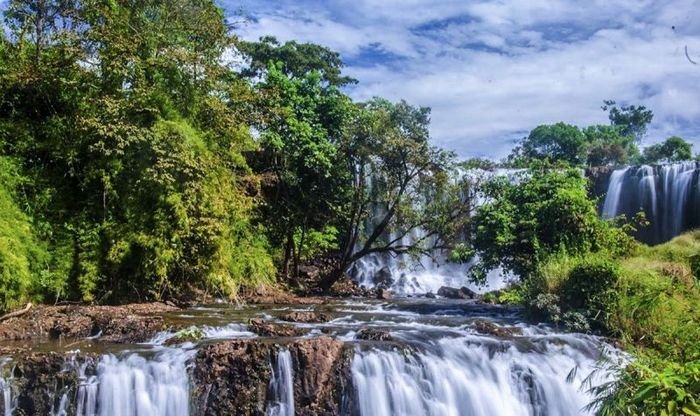
Mo Waterfall or Pác Ban Waterfall, is said to have the ethereal beauty of a young maiden resting in the mountains of Na Hang. Many explorers and tourists have made it a favorite spot for years. Local myths say that Mo Waterfall was named after a woman named Mo who lived with her husband at the base of Pác Ban Mountain. Her husband once left to pick herbs from the forest and never returned. Longing for her partner, Mo went into the woods to look for him and she ended up lost, turning into a waterfall that runs down the rocks every day. For poets, the story of Mo Waterfall is poetic: “The mountains (hide the picture) of the lover between high rocks, tears slowly erode the stones of Nặm Pàn and all the drops flow into Pác Ban’s falls, leaving the sorrowful ones without a way out in Mo’s waterfall.”
Mo Spring starts high in the mountains, where the area is densely forested and the basin is large. It finally empties into the Mo Waterfall. You might choose to get to this beautiful place either by boat which takes you along the river and lets you see the three-level waterfall mirroring a flowing woman’s hair, landing in a peaceful lake. Otherwise, a road paved with stones takes you through the shady forest and butterflies fly around, while you listen to the sounds of nature. The Mo Waterfall Ecotourism Area which covers more than 12 hectares, has all the facilities needed such as guest houses, a pool, restaurants and a boat landing. Enjoying a bit of fresh air and taking a splash in the waterfall are possible here.
Despite the pleasant sound of its name, Mo Waterfall is very energetic. The waterfall has several stages and each stage is more powerful than the last. The third level is rush of power, but the second level is calmer and offers tourists a nice spot to appreciate the falls.
- Na Hang, Na Hang District, Tuyen Quang
Related articles : Top 5 Best Places to Visit in Vĩnh Long – Floating Markets, Islands & Cultural Gems



Pingback: Best Places to Visit in Trà Vinh – Explore Khmer Temples, Beaches & Cultural Gems