
Now Reading: Best place to visit in Kraków
-
01
Best place to visit in Kraków
Best place to visit in Kraków
🏰 1. Wawel Castle – Royal Heart of Poland

Wawel Castle is the most famous landmark in Kraków and one of Poland’s greatest national treasures. Located on Wawel Hill beside the Vistula River, the castle served for centuries as the residence of Polish kings and queens.
The castle complex combines Gothic, Renaissance, Romanesque, and Baroque architectural styles, reflecting different periods of Polish history and royal power.
Inside, visitors can explore royal chambers, treasury collections, historical weapons, tapestries, artworks, and ceremonial halls filled with centuries of history.
Beside the castle stands Wawel Cathedral, where Polish monarchs were crowned and buried.
The cathedral contains royal tombs, chapels, religious artwork, and the famous Sigismund Bell, one of Poland’s national symbols.
Legends of dragons, kings, and medieval heroes further add mystery and fascination to Wawel Hill.
The castle remains the spiritual and historical heart of Poland.
🏛️ 2. Main Market Square (Rynek Główny) – Europe’s Largest Medieval Square

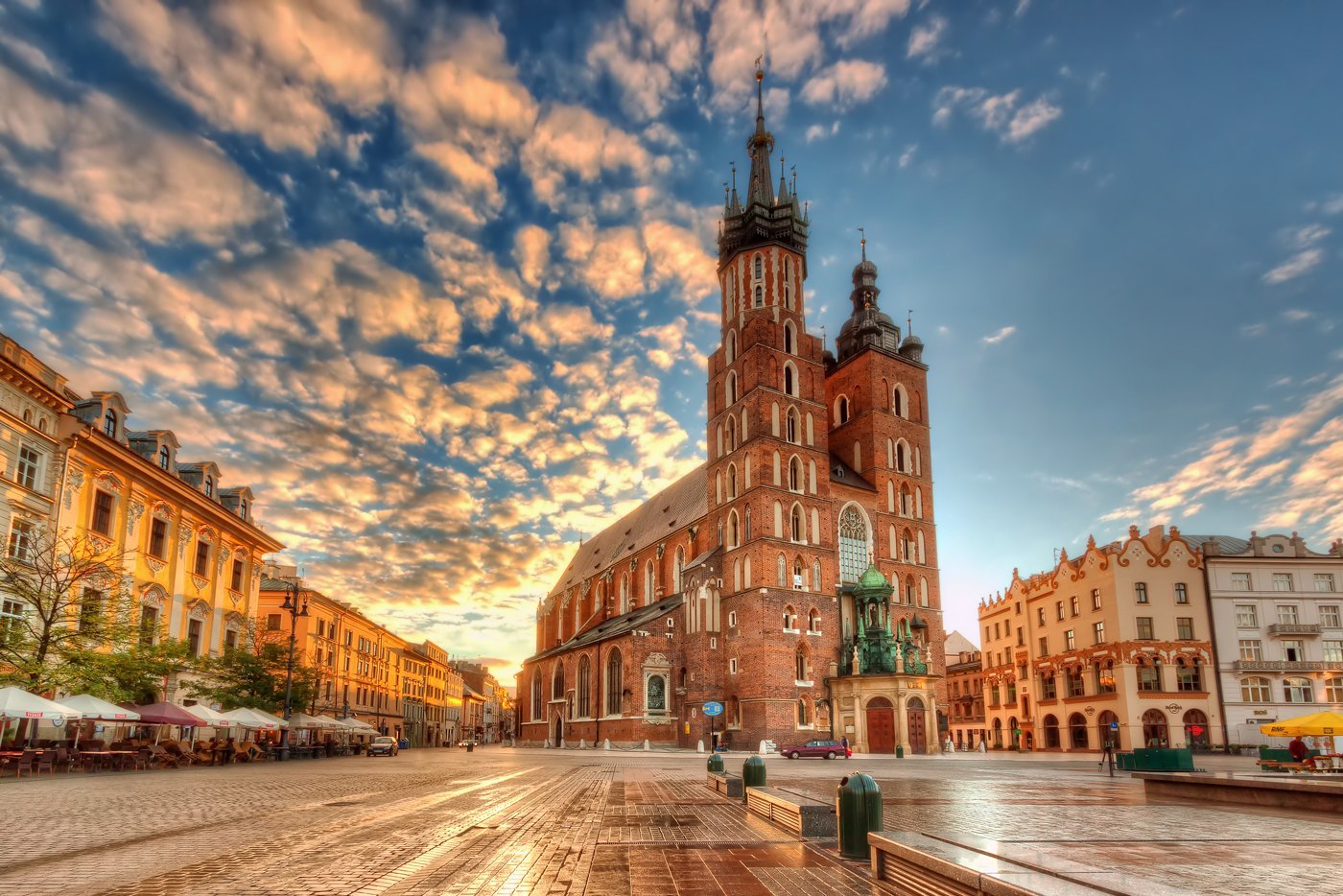
Kraków’s Main Market Square is one of Europe’s largest and most beautiful medieval squares.
Surrounded by colorful townhouses, churches, restaurants, cafes, museums, and historical buildings, the square has been the social and commercial center of Kraków for centuries.
Street performers, horse-drawn carriages, musicians, flower vendors, and outdoor cafes create lively atmosphere throughout the day.
The Cloth Hall (Sukiennice), located in the center of the square, once served as an important trading center where merchants sold silk, spices, textiles, and goods from across Europe.
Today, the Cloth Hall contains souvenir markets and art galleries.
At every hour, the famous trumpet call known as the Hejnał Mariacki is played from the tower of St. Mary’s Basilica, continuing a centuries-old Kraków tradition.
The square perfectly captures the energy, beauty, and history of Kraków.
⛪ 3. St. Mary’s Basilica – Gothic Masterpiece

St. Mary’s Basilica is one of Kraków’s most recognizable landmarks and a masterpiece of Polish Gothic architecture.
Its twin towers dominate the skyline of the Main Market Square and serve as symbols of the city.
Inside, visitors are amazed by the church’s blue ceiling covered with golden stars, stained-glass windows, religious paintings, and intricate wooden altarpiece created by Veit Stoss.
The basilica’s hourly trumpet signal commemorates a medieval trumpeter who warned the city of invasion before being struck by an arrow.
The church remains an active place of worship and one of Kraków’s most beloved historical monuments.
Its extraordinary beauty and spiritual atmosphere make it unforgettable for visitors.
🕍 4. Kazimierz – Jewish Heritage & Cultural Revival

Kazimierz, the historic Jewish Quarter of Kraków, is one of the city’s most culturally significant districts.
For centuries, Jewish communities lived, studied, traded, and worshipped here, contributing greatly to Kraków’s culture and economy.
The district contains synagogues, cemeteries, museums, historical streets, and memorial sites connected to Jewish history and heritage.
During World War II, the Jewish population suffered terrible persecution under Nazi occupation, making Kazimierz an important place of remembrance.
Today, the district has experienced cultural revival and is filled with cafes, galleries, restaurants, bookstores, music venues, and artistic spaces.
Kazimierz beautifully combines memory, culture, history, and modern creativity.
The district became internationally famous after the filming of Schindler’s List nearby.
🏞️ 5. Vistula River & Riverside Walks

The Vistula River flows through Kraków and adds natural beauty and peaceful atmosphere to the city.
Riverside promenades, cycling paths, parks, cafes, and boat cruises make the riverfront one of Kraków’s most relaxing areas.
Visitors enjoy scenic walks with views of Wawel Castle, church towers, bridges, and historical buildings reflected in the water.
The riverbanks become especially lively during summer evenings when locals gather for music, picnics, and outdoor events.
Boat tours along the Vistula allow travelers to admire Kraków from a unique perspective.
The river beautifully connects the city’s historical landmarks with modern urban life.
🖼️ 6. Museums, Art & Academic Culture

Kraków is one of Poland’s greatest cultural and academic centers.
The city is home to the historic Jagiellonian University, founded in 1364 and one of Europe’s oldest universities. Famous astronomer Nicolaus Copernicus studied here.
Museums throughout Kraków display medieval art, royal collections, wartime history, modern paintings, and archaeological treasures.
The National Museum, Czartoryski Museum, and underground historical museum beneath the Main Square are especially popular.
The city also hosts literature festivals, concerts, theater performances, and artistic exhibitions throughout the year.
Kraków’s intellectual and artistic atmosphere gives it extraordinary cultural depth.
⚔️ 7. Auschwitz-Birkenau Memorial – Powerful Historical Experience

Near Kraków lies the Auschwitz-Birkenau Memorial and Museum, one of the world’s most important sites of remembrance.
The former Nazi concentration and extermination camp stands as a powerful memorial to the millions of victims who suffered during the Holocaust and World War II.
Visitors can explore preserved barracks, exhibitions, personal belongings, photographs, and historical documents that educate future generations about the horrors of genocide and intolerance.
The memorial promotes remembrance, peace, and human dignity.
Visiting Auschwitz is an emotional and deeply meaningful historical experience for many travelers.
🍲 8. Polish Cuisine & Traditional Cafes

Kraków offers delicious Polish cuisine influenced by centuries of Central European culinary traditions.
Visitors can enjoy pierogi, soups, sausages, smoked meats, potato dishes, breads, cakes, and traditional desserts throughout the city.
Historic cafes serve pastries and coffee in elegant interiors filled with artistic atmosphere and old-world charm.
Milk bars provide affordable traditional meals popular among locals and students.
Restaurants in Kazimierz also offer Jewish-inspired cuisine and international flavors.
Kraków’s food culture combines comfort, tradition, and hospitality.
🎄 9. Kraków Christmas Market – One of Europe’s Most Beautiful

During winter, Kraków hosts one of Europe’s most magical Christmas markets in the Main Market Square.
Festive lights, decorated stalls, horse carriages, traditional music, mulled wine, handmade crafts, ornaments, and Polish holiday foods create unforgettable atmosphere.
Snow-covered Gothic churches and medieval buildings make Kraków especially beautiful during December.
The market attracts visitors from around the world and perfectly showcases Polish holiday traditions and hospitality.
The Christmas season transforms Kraków into a fairytale winter destination.
🌟 10. Nightlife & Modern City Energy

Kraków is also one of Europe’s most vibrant student and nightlife cities.
Underground pubs, jazz clubs, live music venues, rooftop bars, and cultural cafes create energetic nightlife throughout the Old Town and Kazimierz districts.
The city’s youthful population and artistic communities contribute to a lively and creative atmosphere.
Despite its ancient history, Kraków feels modern, welcoming, and full of life.
The balance between historical elegance and youthful energy makes the city especially attractive for travelers.
Related artical : Best place to visit in Bruges